I recently attended a talk by neurologist and author Robert Burton, entitled Certainty and the Self,
in which he presented some interesting results from psychological experiments, but
then quickly proceeded to non sequitur conclusions about knowledge, the self,
and free will. I came away with a strengthened recognition that thinking clearly
about these ideas is harder than it looks. One would think that a
smart guy like Burton, who's had his fingers in brains (literally) for
decades, would have something useful to tell us about our thinking
selves. Yet, I couldn't help but feel he was out of his depth.
While an expert on what happens inside the brain, Burton employed rather unsophisticated conceptions of knowledge, the
self, and free will. He seemed to assume that knowledge requires certainty and the self and free will presuppose some mysterious non-material
entity. But these assumptions just demonstrate a lack of familiarity with the current philosophical literature about these issues. Philosophers have long recognized
that knowledge is fallible, and outside the department at Notre Dame, very few are dualists these days. I have
noticed a tendency for scientists of different stripes, and laypeople for that matter,
to roll their eyes at philosophers. I once overheard an economist (I'm using "scientist" in the loosest sense here) say, "Oh,
you're a philosopher? Here's a nickel, tell me what you think." But if you want to avoid embarrassment when discussing philosophical issues like skepticism and free will, you may want
to read what people who think about this stuff for a living actually have to say about the issues. Otherwise, you're liable to argue against straw men.
The problem, however, was not limited
to a lack of familiarity with the philosophical literature. Making
valid arguments also seems to be more difficult than I previously thought. Burton gave us an entertaining anecdote about witnesses of 9/11
misremembering what actually happened. The experiment yielded
only about a 10% success rate for those claiming to remember, after 10
years had passed, what happened on that "unforgettable" day. One
subject was so sure that his memory was correct that he insisted that
what he had written in his journal a mere two hours after the incident must have been mistaken. But from this anecdote, Burton not
only concluded that eyewitness testimony and memory are unreliable, but
that this was also evidence that we lack conscious thought
altogether. Where did that come from? Now, maybe he was trying to be provocative and get a rise from us, but he didn't stop there. He
later claimed that neurological evidence shows that reasoning is subjective and idiosyncratic, and, therefore,
no one way of reasoning is better than another (so why, again, should I pay attention to arguments made from neuroscience?).
At this point, I pushed
back. I asked him, if he were truly committed to that position,
was he willing to accept that believing the earth is flat is just as
reasonable as believing its spherical. Surprise! He wasn't willing
to accept that. In turn, he admitted that science gives us objective
knowledge of the world, but circumscribed its domain to that which could be subjected to controlled, empirical experiments.
Presumably, he meant the self and free will were not objects of
scientific study, and therefore, only idiosyncratic opinions could be asserted about such matters. In other words, objectivity for the scientific world; relativism for everything else. But how does one know where to draw the line between science and non-science? In essence, Burton was reaffirming the dichotomy that led to Karl Popper's demarcation problem. The trouble is, all attempts to provide a criterion for distinguishing between science and pseudoscience ultimately fail. Either the criterion is too strong, and even physics fails the test, or it's too weak, and astrology passes. Or, surprisingly, a single criterion, like falsifiability, proves both too strong and too weak thanks to the underdetermination of theory by evidence. Again, if Burton were familiar with the philosophical literature in the philosophy of science, he would know he was heading down a dead-end.
All in all, Burton had good intentions. His skepticism was motivated by a disdain for hubris; he offers a warning against those who make absolute claims without the grounds to do so. Yet, his doubts about the self and free will stem more from an oversimplification of the concepts themselves than any neuroscientific evidence. Even more sinister, his assertion that reason is subjective and relative risks undermining the science on which he bases his conclusions. He unintentionally advanced a radical skepticism that leads to an anything-goes relativism that he doesn't actually endorse.
Recommended read: Eddy Nahmias offers a succinct philosophically sophisticated account of the scientific challenges to free will.
Saturday, February 22, 2014

Saturday, February 15, 2014
Robot Suffrage Now!
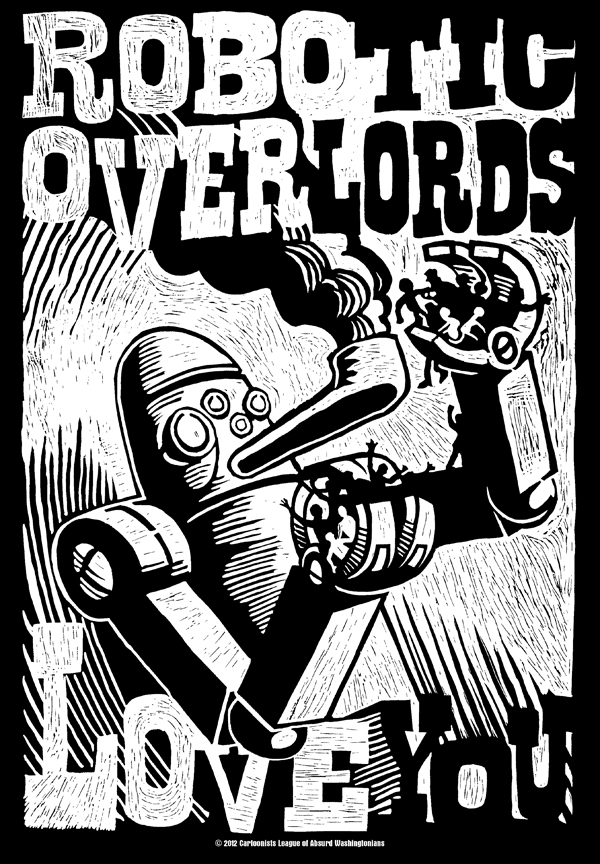
After recently discovering this thing called the technological singularity, I want to be on the right side of history here. I may be jumping the gun by a few decades (or centuries), but with my first post, I, hereby, attest to my future robot overlords: I'm on your side.
Robot suffrage now and forever!
Subscribe to:
Posts (Atom)